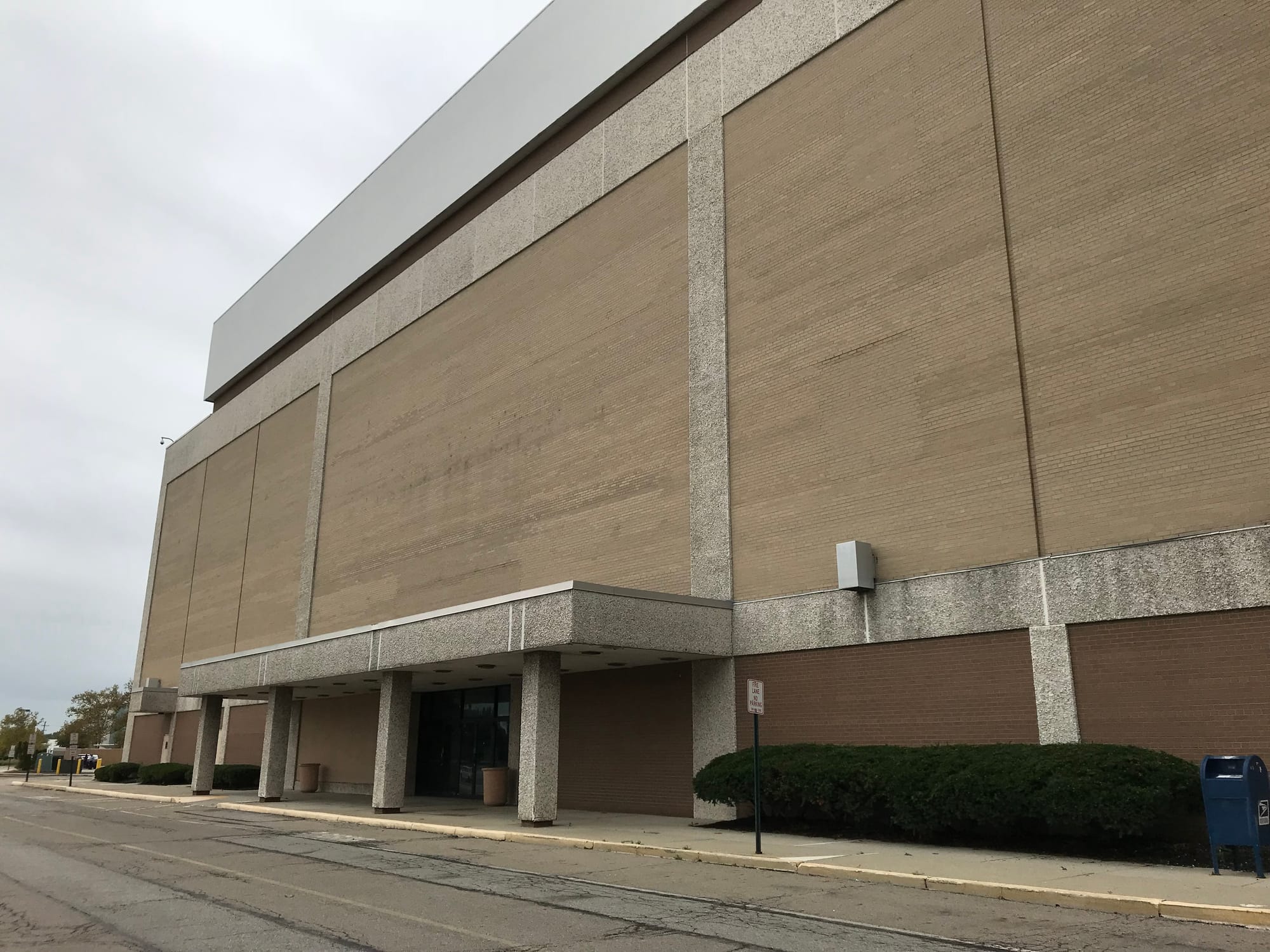
YOU‘VE BEEN HERE BEFORE

On January 6, 2017, 71-year old Bernard Gore was spotted pacing back and forth in front of the Chanel store at the Westfield Bondi Junction Mall in Sydney Australia. After doing a little shopping, he was to meet his wife by the parking lot in front of the Woolworth's, but couldn't find the way out. A Chanel employee asked him if he needed help, but he shook his head and wandered off. He eventually spotted a door marked EXIT and walked through. He would never walk out.
Gore inadvertently went through a fire exit that automatically closed and locked behind him. Suffering from dementia and Alzheimer’s, he got lost in the eight miles of stairs and hallways. There were only two points of egress: the roof parking lot or the basement six flights down. None of the levels had phones or help points. After a three-week search, his body was finally found.
The coroner found no evidence of traumatic injury, and while Gore was suffering from some pre-existing medical conditions, the “psychological, environmental and physiological stressors experienced as a result of being stuck inside the stairwell were possible significant contributors to his death.”
Shopping malls are designed to confuse. The moment we enter a mall or big box store we are surrounded by an intentionally labyrinthian floor plan. Overwhelmed by its size, we lose track of our original intentions and forget our diligently-made shopping lists. We go to stores we never intended to, we buy things we don’t need, and we spend more money than we should have. It’s a phenomenon known as the Gruen Transfer or Gruen Effect named after architect Victor David Gruen the creator/designer of the modern American shopping mall. Gruen’s original idea was to create an indoor, community marketplace, an interior replica of the cities commercial district, a suburban agora. Gruen would later denounced his invention hating that this methodology of consumer manipulation was named after him.
As Bernard Gore would discover, there are two sides to the mall maze: the interior and the interior of the interior. The public space is bright, spacious, clean, designed to be welcoming and enticing. Then there is the private space, the utilitarian backside never meant to be seen that is just as vast, just as confusing, but hidden, empty, dark and lifeless.
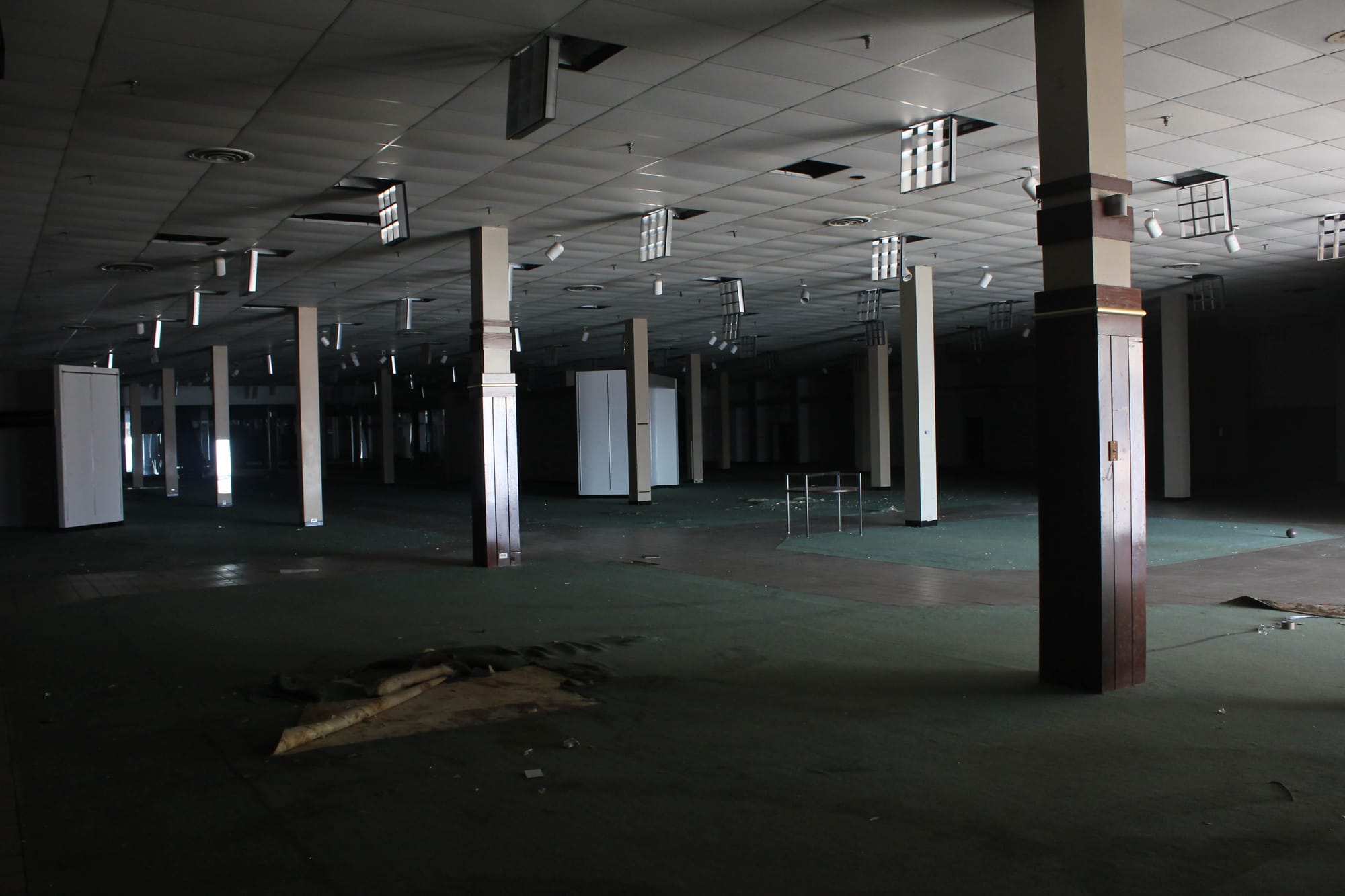
In between these outside/inside, front/back spaces is the abandoned mall. In the dead mall, spaces originally designed for specific purposes, intents, populations, and social conditions (albeit contrived social conditions) are made irrelevant and left to decay, with sparse remnants of its former life.
Malls are an artificial construction designed for both comfort and confusion which makes the dead mall equally disquieting and fascinating. Coupled with nostalgia, it is familiar but uncanny. Both innocuous and hostile.
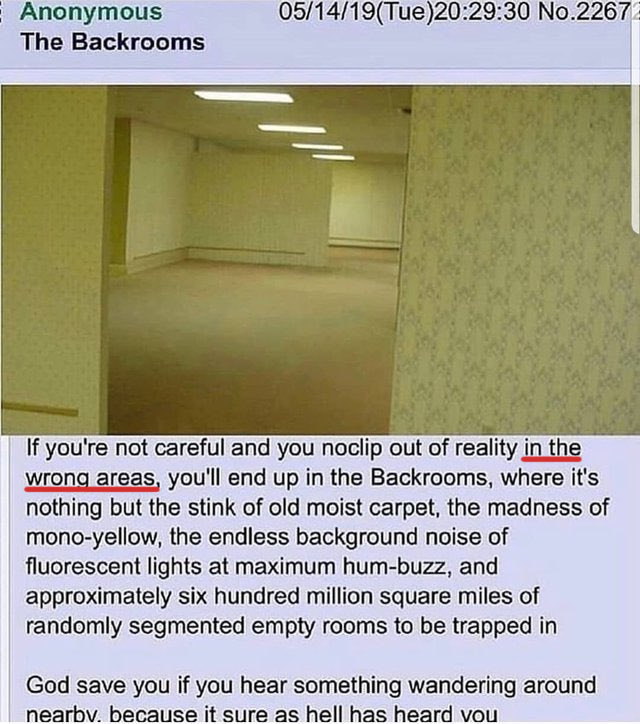
On May 12, 2019, a photo was posted anonymously to a paranormal 4chan board asking members to post “disquieting images that just feel off.” The photo is shot at an awkward angle looking into an empty, windowless room divided into awkwardly proportioned walls with yellow patterned wallpaper, harsh fluorescent lighting, and drop-down ceilings. It’s creepy but it’s hard to say exactly why.
On May 14th, an anonymous member titled the image “The Backrooms” and added a caption:
If you’re not careful and you no-clip out of reality in the wrong areas, you’ll end up in the Backrooms, where it’s nothing but the stink of old moist carpet, the madness of mono-yellow, the endless background noise of fluorescent lights at maximum hum-buzz, and approximately six hundred million square miles of randomly segmented empty rooms to be trapped in. God save you if you hear something wandering around nearby, because it sure as hell has heard you.
A banal but disconcerting photo is posted on 4chan; someone creates a caption for it; someone else expands the caption to a Creepypasta story on Reddit, and from there a mythological world blossomed with user determined rules and lore. The subreddit r/backrooms now has over 300,000 members, with thousands of stories, video games, and 3D animated videos.
The Backrooms is an alternate dimension outside of the boundaries of known reality, in which people accidentally find themselves by “no-clipping” into it. To no-clip in gaming lingo, refers to a cheat code that allows a player to pass through solid objects within the game. It’s come to mean the act of passing through this reality to another extra-dimensional space. The Backrooms consist of an infinite number of levels each with it’s own characteristics. It’s inhabited by creatures known as Entities. “Some are out for blood, others are out for cuddles, and some are more human than we could ever hope to be.”
There are multiple canons about the origins and purpose of the Backrooms, each with their own storylines. But the most famous is Backrooms, a 21-episode YouTube series created in 2022 by Kane Parsons (aka Kane Pixels), set to be released as an A24 film in 2026. The original series of shorts spawned hundreds of fan videos, each with their own take on the Backrooms experience.
The typical Backrooms video starts with the POV perspective of someone shooting a video, a common found footage trope. They accidentally stumble and drop through some invisible void into a spacious, empty yellow room. It doesn’t seem residential, but it’s not quite commercial. It’s strange but not totally alien. As they meander in confused awe looking for the way out, it gets stranger and stranger. There are passageways inside passageways with doors in odd proportions in impossible places. Every hallway leads to another hallway. There’s office furniture in random places giving the illusion of an ordinary commercial space. Each hopeful doorway leads to new rooms, some crowded with walls, others are impossibly vast open spaces. Soon, eerie animalistic cries can be heard in the distance and shadowy forms appear around corners. There are no exits.
* * *
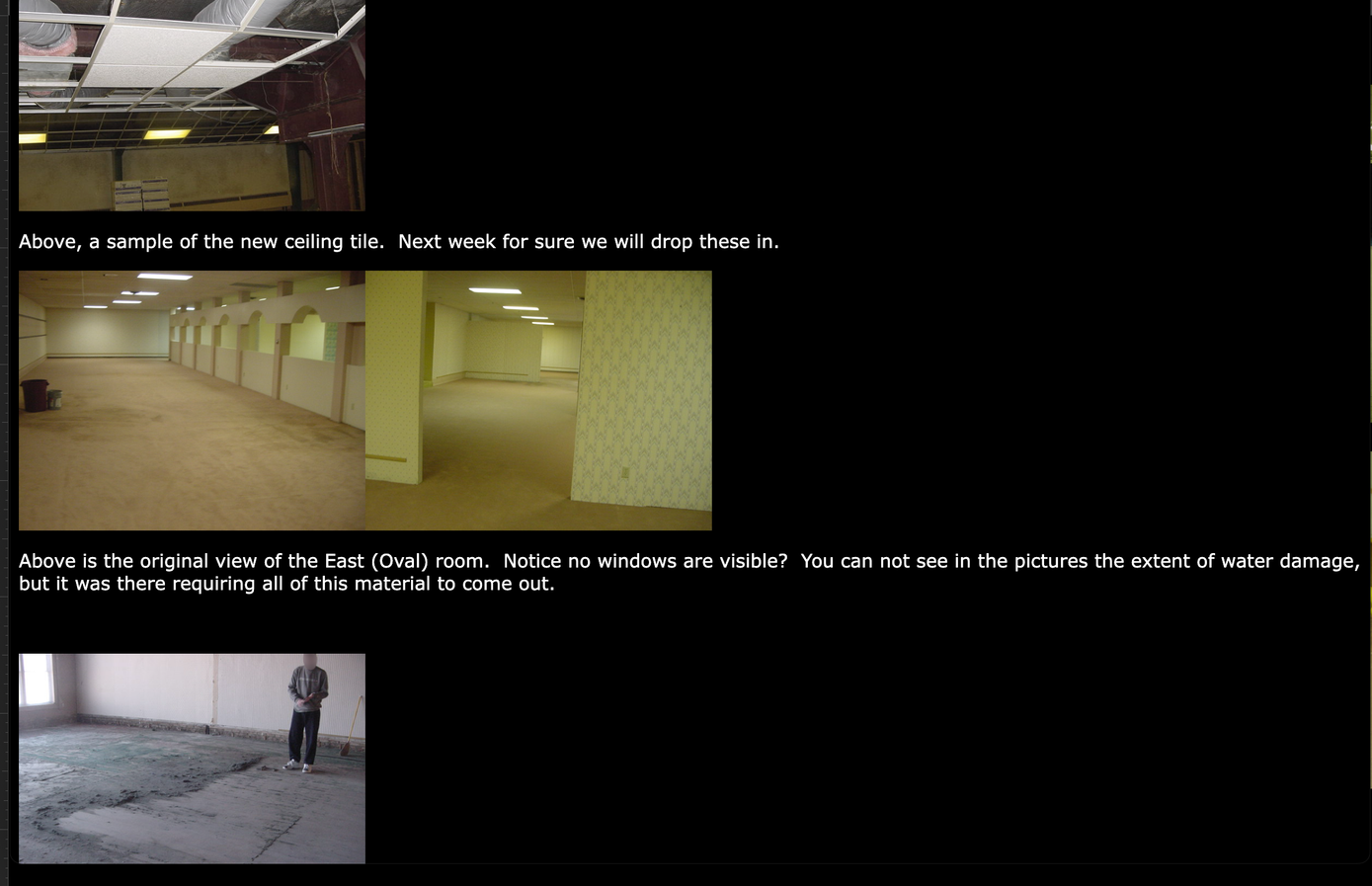
While some fans are focused on the fictional lore, others are convinced the Backrooms are real, determined to find it’s secret location and purpose. The yellow room was indeed a real place with a real purpose: a former furniture store in Oshkosh, Wisconsin (see The real story behind the Backrooms by Kendra Gaylord.) The original Backrooms image was traced to an archived webpage from March 2003 in a collection of photos documenting the renovation of an old furniture store to a hobby shop. The antechamber to the Backrooms universe was simply a furniture store showroom now devoid of furniture.
The photo is often described as feeling like a liminal space. In his essay Betwixt and Between: Zones as Liminal and Deterritorialized Spaces, Peter Heft writes:
The concept of liminality explains the oddness we feel when we’re in spaces devoid of their proper context. Liminal states are neither here nor there; they are betwixt and between the positions assigned and arrayed by law, custom, and convention.
Liminal spaces fall into an uncanny valley of architecture. Familiar places that are almost correct but not quite, devoid of people, detail, context and purpose. Chris Frewerd became one of the first to post a short story on Reddit’s r/CreepyPasta. The Backrooms image reminded him of the library in his hometown in Kansas, his old school, and the playgrounds in the middle of shopping malls.
So many people grew up in the odd transitional period of the 2000s, where things from the past sat almost completely unchanged, unmaintained, buildings unrenovated. A lot of the common locations in my life up to that point were these older, slightly run-down buildings with dated interior design and very odd auras surrounding them. The Backrooms is the perfect culmination of this.
These abandoned commercial spaces are the extraneous leftovers of a constructed world made obsolete room by room. Architect Rem Koolhaas refers to these places as Junkspace.
Junkspace is the residue mankind leaves on the planet. Junkspace is what remains after modernization has run its course, or, more precisely, what coagulates while modernization is in progress, its fallout. It is the product of an encounter between escalator and air-conditioning, conceived in an incubator of Sheetrock. It is always interior, so extensive that you rarely perceive limits; it promotes disorientation by any means…
* * *
The tagline on the Backrooms wiki page reads “You’ve been here before.” There’s a faint sense of familiarity about the image, but it’s just off enough to feel eerie, even menacing. Freud called that uncanny dread unheimlich. Heimlich in German means “familiar” or “homey.” Unheimlich is the “creeping horror” of something once known and comforting turning alien and frightening.
The Backrooms photo is unheimlich.
Interior spaces are by nature finite and limited to the dimensions of the structure. If there is an entrance it stands to reason that there would be an exit. There is something particularly frightening in being lost in an interior space, like Bernard Gore, especially in a place that’s known to us, a place meant to be reassuring at best, boring and banal at worst.
Last year around Christmas, I was on my way to an event near Rockefeller Center (which alone is infuriating enough). I walked out of the subway and into a concourse of restaurants and shops Under the Rock. I followed what I thought were exit signs, walking past the same steakhouse over and over again. Running late, sweating under my puffy coat, my panic rose. I asked a security guard, “How do I get out of here?” He pointed towards the same direction I came and I thought with growing dread, “I'm going be stuck forever underneath the Rockefeller Center Christmas tree.” But unlike Gore, I was inside, not inside of the inside. My frustration and panic lasted minutes, not days. Unlike the Backrooms, I wasn’t a victim of supernatural forces or a secret scientific experiment gone wrong, but of poor planning and a lack of wayfinding. Unlike Gore, I wasn't alone and the Entities were just tourists.
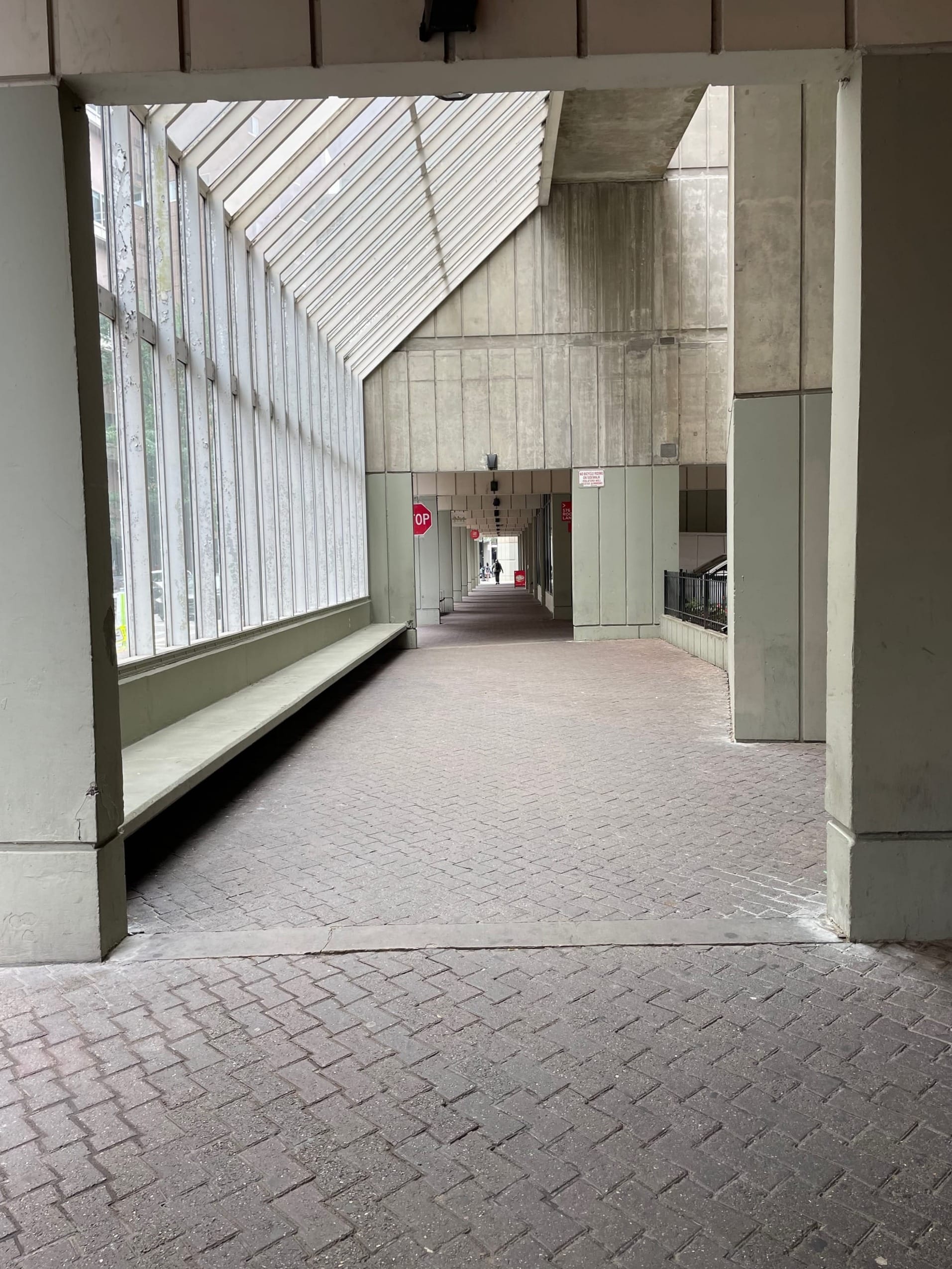
There’s been a rise in a new kind of horror: rooms devoid of people, vast spaces of constructed banality, inhumanly pristine with a disturbing twist: pools in tiled rooms with no exit, endless rows of empty office cubicles (see Severance). This isn’t the dilapidated Victorian mansion, but the shells of failed third spaces. They are the public ghosts of capitalism, not the poltergeist of the private home. But like the haunted house, the terror is always inside.
The introduction of the Backrooms wiki reads:
They say that it’s an afterlife–not for people, but for places. For every chain storefront demolished, every retail outlet bought out, every dead mall razed to the ground. A limbo for every building without purpose, those in-between spaces.
I like this interpretation, that dead malls could have an afterlife, that these Junkspaces seem eerie and strange because they’re not meant for us, at least not anymore. I think buildings have something of a soul, a memory, that cinderblock and ceramic tiles can absorb traces of the life inside them. Perhaps when we encounter these uncanny spaces, we’re not looking at our own nightmares, but of some poor abandoned Orange Julius or Radio Shack’s dream.